MolVerity AI evaluates more than predictive accuracy. Predictive discrimination alone is not sufficient for scientific decision support; calibration, uncertainty, chemical-domain coverage and robustness under distribution shift also matter.
The present MolVerity research framework has been developed and benchmarked primarily for toxicity prediction. Six endpoints are currently implemented in ToxVerity. Broader ADMET functionality represents planned platform expansion and should not be interpreted as currently validated production capability.
Each implemented endpoint is modeled to reflect its biological endpoint, dataset and intended decision context.
Evaluation accounts for structural scaffolds to reduce overly optimistic estimates.
Models are assessed across repeated runs rather than relying on one split.
Raw model outputs are calibrated to improve probabilistic interpretability.
Ensemble disagreement is quantified alongside predictions.
Each prediction is evaluated against represented chemistry.
Molecules outside the model-development domain are flagged.
The platform can decline a forced prediction when support is insufficient.
Model behavior is assessed on held-out external data where available.
Performance estimates include uncertainty ranges.
Known endpoint and model limitations are documented.
Model releases and predictions are designed for traceability.
MolVerity combines classical machine learning, neural networks and graph-based deep learning for molecular property prediction. The MolVerity framework evaluates multiple model families for each endpoint rather than assuming that a single architecture is optimal across all prediction tasks. Model selection is guided not only by predictive performance, but also by calibration, uncertainty, applicability domain and out-of-distribution behavior to support reliable molecular screening.
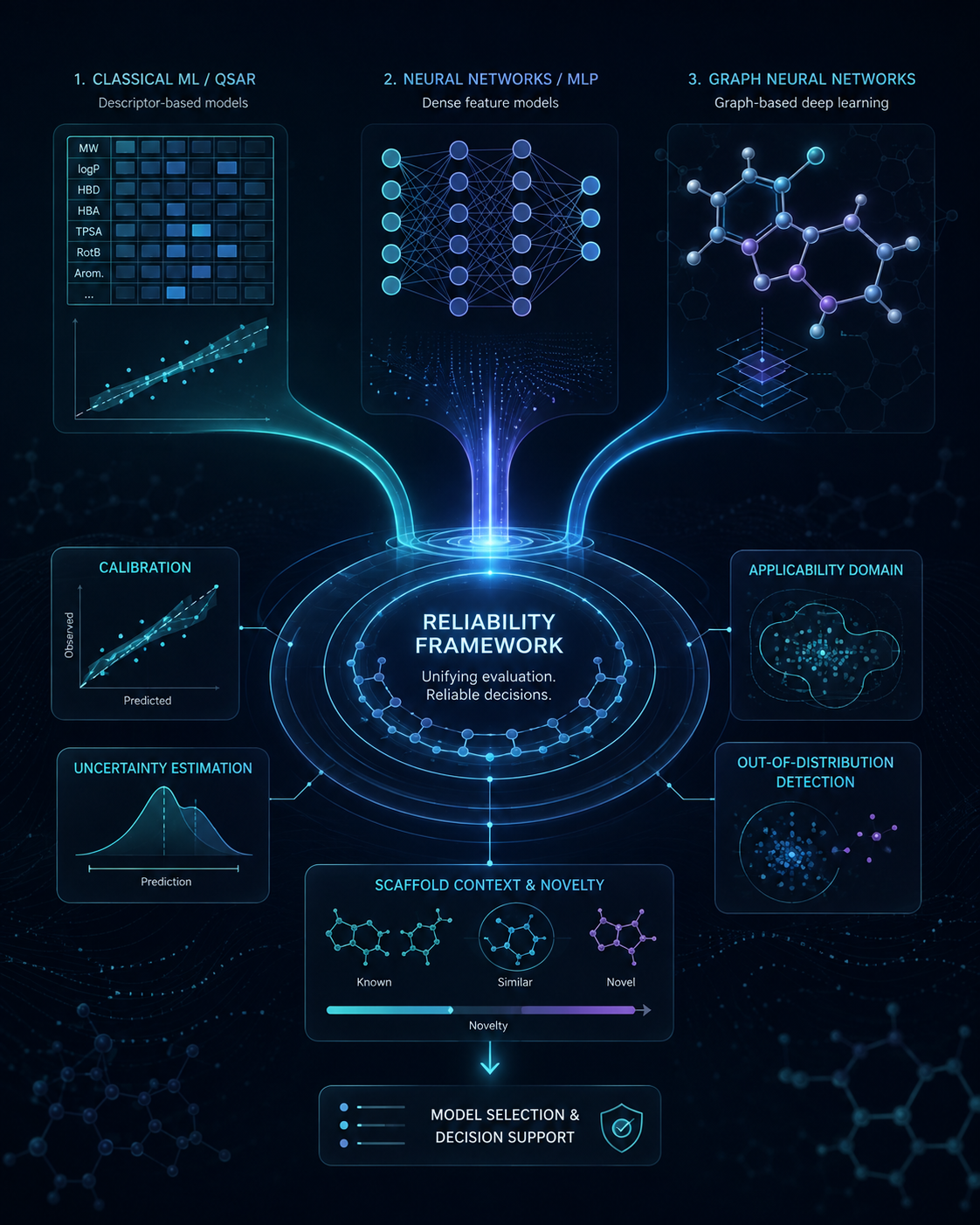
Molecular fingerprints are evaluated with established machine-learning methods including logistic regression, random forest, support vector machines, histogram gradient boosting and XGBoost where available. These models provide endpoint-specific QSAR benchmarks and comparative baselines.
Multilayer perceptron neural networks learn nonlinear relationships from molecular fingerprint representations. Both single-task and multitask architectures are evaluated to study endpoint-specific performance and shared representation learning.
Molecular structures can also be represented directly as graphs of atoms and bonds. The MolVerity research framework includes Graph Isomorphism Networks (GIN) and graph-attention architectures based on GATv2, with both single-task and multitask implementations.
Model architecture alone does not determine whether a prediction should be trusted. Candidate models are evaluated alongside probability calibration, ensemble uncertainty, applicability-domain coverage, molecular similarity, scaffold novelty, out-of-distribution detection, abstention criteria and external validation where suitable data are available.
Formal documentation will be published as it becomes available. This page does not present fabricated performance claims.
To be published.
To be published.
To be published.
To be published.
To be published.
To be published.
Reach out for methodology questions, academic collaboration or available documentation.
