
ToxVerity
Reliability-centered toxicity screening demonstrated through the current six-endpoint benchmark panel.
MolVerity AI is designed as an endpoint-flexible molecular intelligence platform, not a single fixed model. ToxVerity is the first implemented module today; additional toxicity endpoints and planned ADMET modules can extend the same reliability-centered architecture as suitable models and validation evidence become available.
This conceptual interface illustrates the intended MolVerity product experience. ToxVerity is the current implemented module; embedded values and interface details in the illustration are examples only.
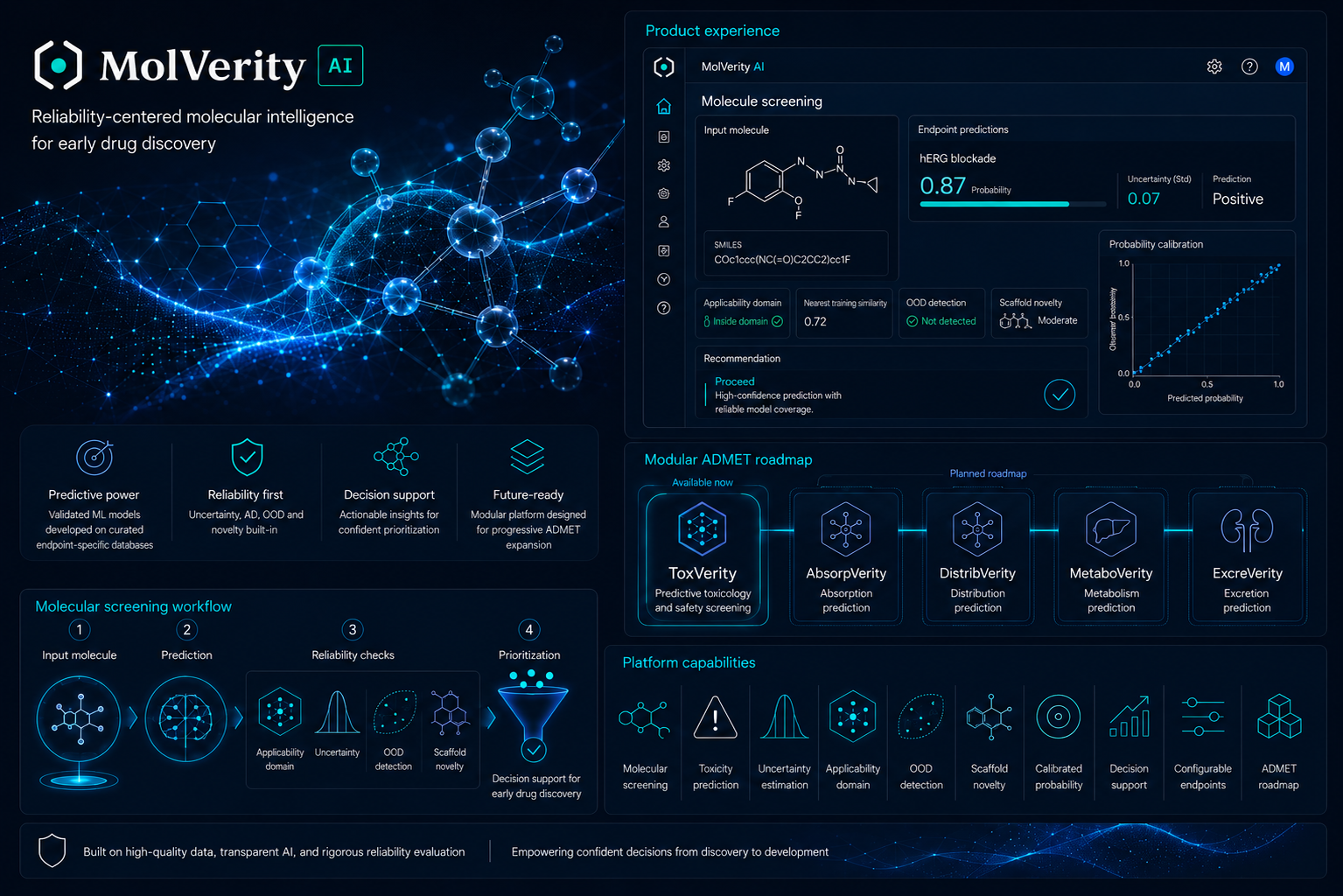
Reliability-centered toxicity screening demonstrated through the current six-endpoint benchmark panel.
Future absorption intelligence for validated properties such as solubility, permeability, and related early-discovery endpoints.
Future distribution-focused intelligence for validated endpoints relevant to compound disposition.
Future metabolism intelligence as suitable validated metabolic-liability and enzyme-interaction models become available.
Future excretion and elimination-related predictive capabilities as suitable models and validation evidence become available.
ToxVerity currently demonstrates the platform across a benchmark panel of six toxicity endpoints while assessing calibration, uncertainty, applicability domain, scaffold novelty, out-of-distribution status and abstention.
Screening programs can be configured around the available validated endpoints most relevant to a customer’s discovery program, therapeutic area, chemical space, development stage and internal risk priorities.
Select from the validated endpoint models available in the MolVerity library rather than relying on one fixed panel for every program.
Calibration, uncertainty, applicability domain, similarity, scaffold novelty, OOD detection and abstention remain part of the decision context.
New endpoints are incorporated only when suitable models, validation evidence, calibration, applicability-domain assessment and decision criteria are available.
Planned web access for research organizations at app.molverity.com.
For organizations requiring greater confidentiality and control over molecular data and infrastructure.
Future deployment for organizations requiring candidate structures to remain within their infrastructure.
Proprietary molecular structures are commercially sensitive intellectual property. These principles guide the commercial architecture as capabilities are built and validated.
Data in transit is encrypted in commercial deployment.
Data at rest is protected in commercial deployment.
Customer data separation is a core architecture objective.
Access is planned to be scoped by role.
Retention controls are planned for commercial deployment.
Activity traceability is part of the enterprise roadmap.
Predictions are designed to be traceable to model versions.
Customer-controlled deletion is part of the deployment roadmap.
The planned MolVerity API is designed to integrate validated molecular intelligence into computational discovery workflows, supporting high-throughput screening, cheminformatics pipelines, programmatic result retrieval, endpoint selection and reproducible model-version tracking.
POST /v1/screen
{
  "molecules": ["SMILES_1", "SMILES_2"],
  "endpoints": ["selected_endpoint"],
  "model_version": "pinned"
}
Illustrative request schema — the MolVerity API is a planned capability and the final endpoint names, request structure, authentication and versioning contract may change.
Book a walkthrough of ToxVerity or discuss a pilot on your own molecular library.