

Calibrated prediction
Endpoint-specific probabilities calibrated to improve probabilistic interpretation.
Reliability-centered molecular intelligence for early drug discovery — starting with toxicity and expanding toward configurable ADMET screening. MolVerity AI helps discovery teams prioritize candidates while making uncertainty, chemical-domain support, and prediction limitations visible.

Every prediction should be interpreted with uncertainty, domain support, scaffold context, and out-of-distribution checks — not as a standalone score.
Drug discovery remains expensive and high risk. Experimental toxicology remains essential — but screening every candidate experimentally at the earliest discovery stage is costly and time-consuming.
Liabilities discovered late in a program are far more expensive to address than liabilities identified during early candidate selection.
Discovery teams cannot run full experimental toxicology on every candidate in a library — resources must be prioritized.
Computational screening can help teams decide which compounds should receive scarce experimental resources first.
ToxVerity is MolVerity AI’s first implemented module: toxicity intelligence for early small-molecule screening, combining endpoint predictions with a structured reliability assessment.
Endpoint-specific toxicity classifications with calibrated probabilities.
Decision thresholds fixed prior to evaluation for defensible, reproducible calls.
Ensemble disagreement quantified alongside every prediction.
Assessment of whether a candidate is represented by training chemistry.
Nearest-training similarity, scaffold novelty, and out-of-distribution detection.
Structured recommendations for experimental follow-up, including abstention.
Bacterial mutagenicity-related activity for early genotoxicity screening.
Potential blockade of the cardiac hERG potassium channel.
Oxidative-stress response associated with antioxidant-response-element activation.
Cellular response associated with DNA damage and genotoxic stress.
Mitochondrial membrane-potential disruption.
p53-mediated cellular stress response.
MolVerity evaluates not only what a model predicts, but also how strongly the available evidence supports that prediction.
Endpoint-specific probabilities calibrated to improve probabilistic interpretation.
Model disagreement quantified alongside each prediction to communicate stability.
Assessment of whether a candidate is represented by model-development chemistry.
Nearest-training similarity and scaffold novelty provide structural context around each result.
Potential out-of-distribution candidates are identified rather than silently treated as routine predictions.
When evidence is insufficient, the framework can decline to issue a supported binary classification.
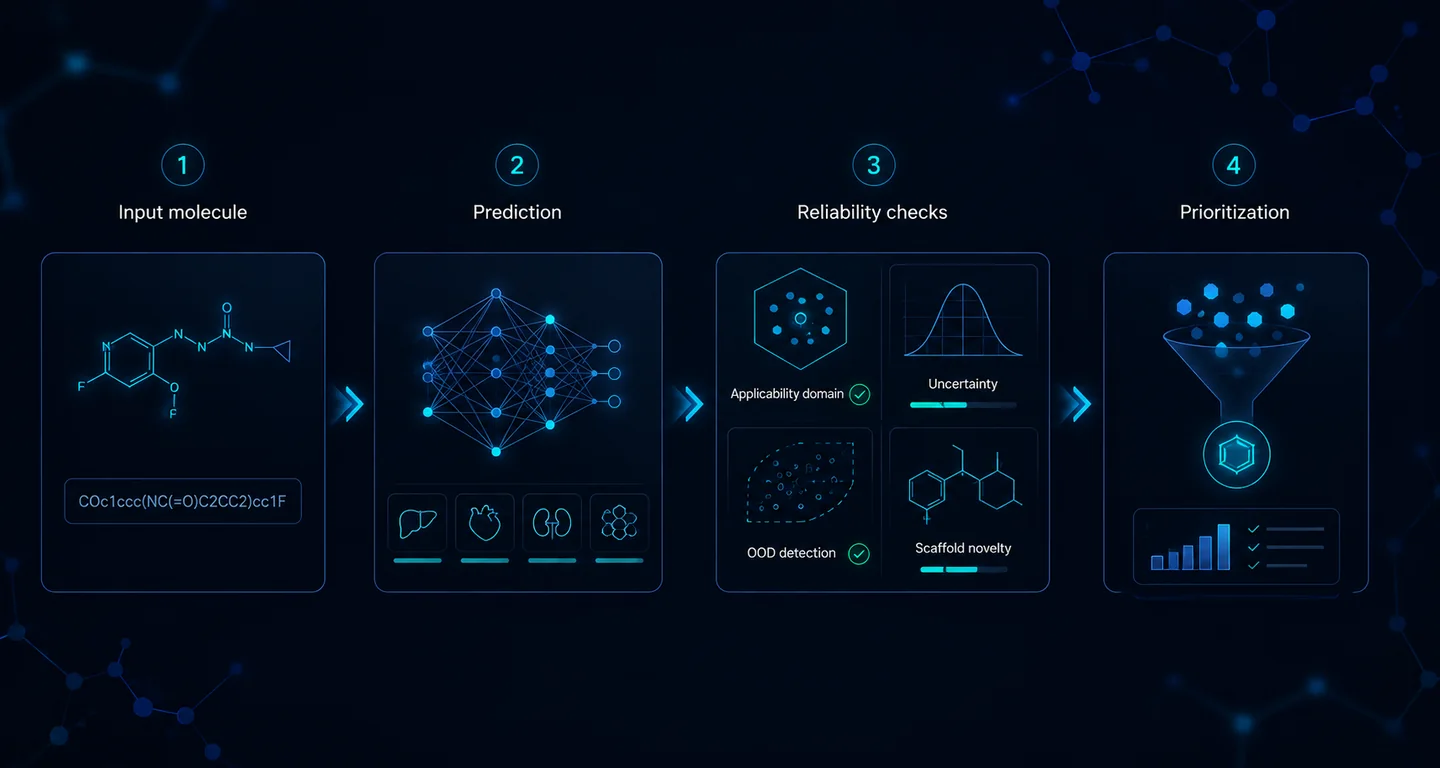
Submit an individual molecular structure or a screening set.
Relevant validated endpoint models evaluate the candidate.
Calibration, uncertainty, applicability domain, molecular similarity, scaffold novelty, and OOD status are evaluated alongside the prediction.
Results are translated into structured decision support while keeping prediction limitations visible.
Representative screening output. Values shown are illustrative only and do not reflect validated model performance.
| Endpoint | Predicted Outcome | Cal. Probability | Threshold | Uncertainty | AD | Recommendation |
|---|---|---|---|---|---|---|
| hERG | Predicted Active | 0.71 | 0.55 | Low | Inside | Confirm in vitro |
| Ames | Predicted Inactive | 0.22 | 0.50 | Low | Inside | Standard priority |
| SR-p53 | Abstained | 0.51 | 0.50 | High | Boundary | Insufficient support |
MolVerity separates current capability from planned expansion. The reliability layer is designed to remain consistent as new validated endpoint models are introduced.
Current benchmark panel: six toxicity endpoints with calibration, uncertainty, applicability-domain, OOD and abstention assessment.
Additional validated toxicity endpoints and configurable assessment panels built from the available model library.
AbsorpVerity, DistribVerity, MetaboVerity and ExcreVerity introduced progressively as suitable models and validation evidence become available.
Customer-relevant screening panels spanning validated toxicity, absorption, distribution, metabolism and excretion endpoints within one reliability-centered workflow.
Discuss a research pilot and evaluate how reliability-aware computational toxicity screening can support your discovery workflow.


